
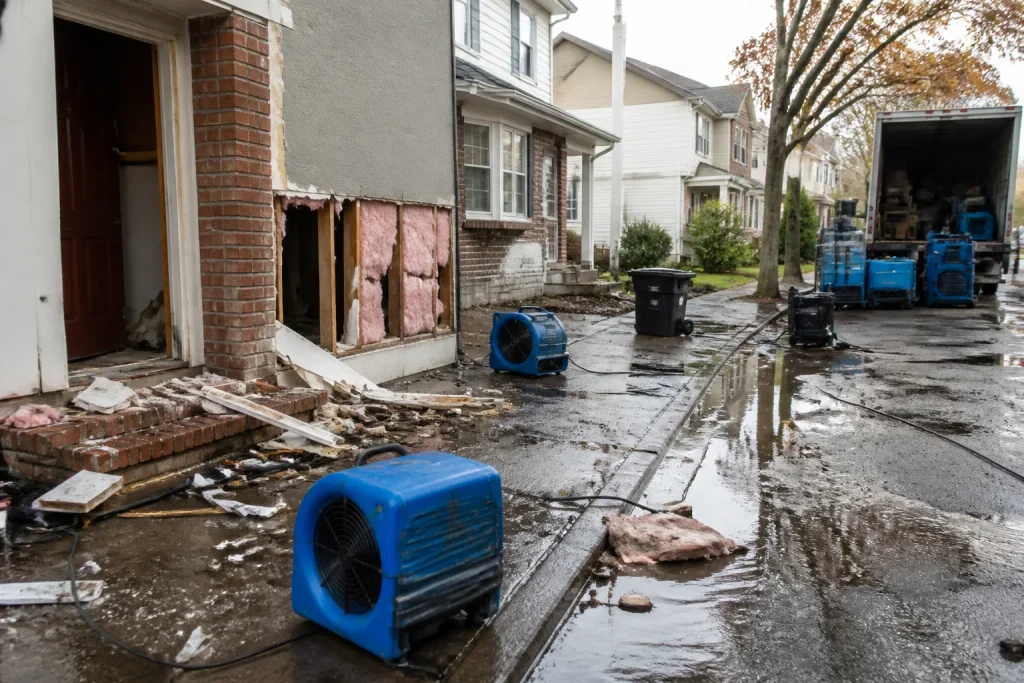
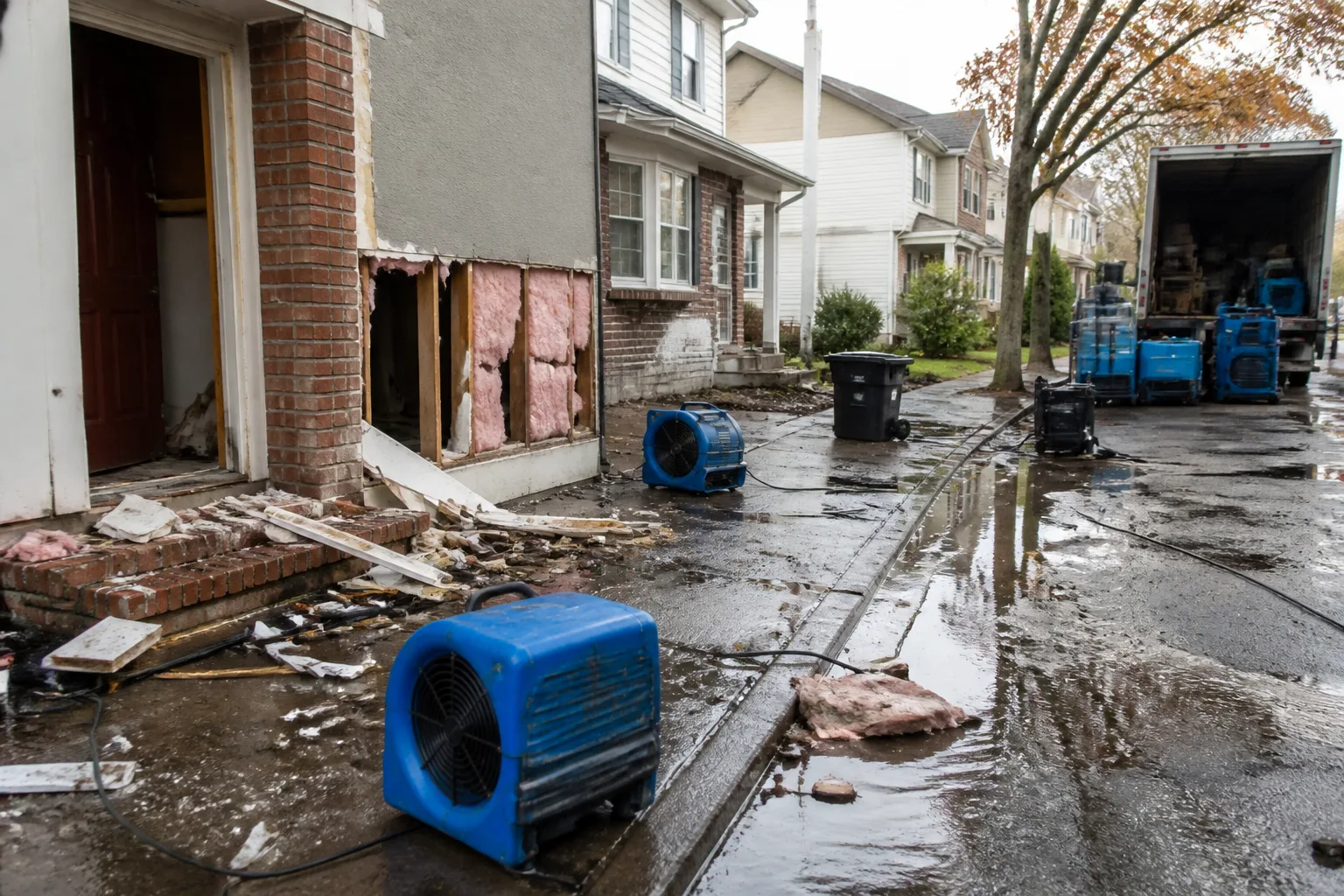
How to Choose the Right Damage Restoration Company in Union City
Choosing a damage restoration company in Union City comes down to one question: who is still contractually responsible for your home 90 days after the last truck leaves? Most companies aren’t. They extract, they dry, they hand you a bill and a handshake, and six weeks later when mold shows up behind the baseboard, you’re making phone calls nobody returns. You want a company that puts its obligation in writing and stands behind it long after the invoice clears. If you’d rather not spend your weekend vetting contractors, call Floodline Restoration Co. at (551) 348-8481 and we’ll walk you through it.
Key Takeaways
- IICRC certification is a baseline, not a differentiator. Ask who holds the certification: the company or the person standing in your home.
- Always ask whether the same crew handles extraction, drying, and rebuild, or whether you’ll get handed off mid-job.
- Your insurance company’s “preferred vendor” list is not a recommendation. It’s a cost-containment mechanism. New Jersey law gives you the right to choose your own contractor.
- A moisture log is non-negotiable. If a company won’t commit to daily readings and a written log, walk away.
- A 90-day written guarantee is the clearest signal that a company actually believes in its own work.
Baseline Credentials: What Actually Matters on the Truck
Every restoration company in Union City lists IICRC certification. It’s on trucks, it’s on websites, it’s on the invoice. And it matters, but not the way most homeowners think. The question is not whether a company has IICRC credentials. The question is whether the specific technician who shows up at your front door holds an individual certification, or whether the company holds a firm certification and sends whoever is available. There’s a real difference.
An IICRC firm certification means the company has met certain administrative standards. An individual technician certification means a named person passed a specific exam in water damage restoration, applied structural drying, mold remediation, or fire and smoke restoration. When you’re standing in your flooded basement at 2 a.m., you want the second one. You want to know that the person reading the moisture map and setting up the drying chamber has been tested on exactly that skill.
Ask this directly: “Will the technician on my job have an individual IICRC certification? Can I see it?” A good company will show you. Our crew at Floodline Restoration Co. carries individual certifications through IICRC, RIA, and IFA standards, because the person holding the moisture meter should know more than the salesperson who answered the phone.
Company Certification vs. Technician Certification
- Company certification: the business has met organizational requirements. It does not guarantee who shows up.
- Individual technician certification: a named person passed a rigorous exam. That’s the person you want in your crawl space.
- The question to ask: “Who holds the certification, and will that person be on my job?”
In Union City, where basements flood regularly and older row houses hide moisture issues behind decades of renovations, this distinction isn’t academic. It’s the difference between a drying plan that actually works and one that looks good on paper. When you’re dealing with water damage restoration in Union City, comfort with your crew is as important as the equipment they bring. See our full Water Damage Restoration in Union City page for specifics about how our crews handle your home.
The Single Point of Contact: Why Handoffs Are Where Jobs Go Wrong
Here’s a scenario we see all the time in Union City. Homeowner calls Company A. Company A sends an extraction crew. That crew leaves. Company A sends a different crew to run dehumidifiers. That crew leaves. Then a project manager calls to schedule rebuild. Except the project manager has never seen the house. The rebuild crew has never seen the moisture log. And the homeowner is now the de facto general contractor, relaying messages between three different teams and an insurance adjuster who’s getting more confused by the day.
That mid-job handoff is where restoration jobs go sideways. It’s where miscommunications happen, where moisture gets missed, where rebuild crews work off incomplete information. Ask every Union City restoration company this before you sign anything: “Who is my single point of contact from extraction through final inspection, and does the same crew handle the entire job?” If the answer is anything other than a clear “yes,” keep looking.
We pulled one out of a garage over near the Summit Avenue corridor last year where the homeowner had already paid another company for extraction. That company finished the water removal and disappeared. No drying log, no rebuild estimate, no returned calls. The homeowner had a half-finished job and a carrier demanding documentation. We ended up redoing the whole thing from the moisture map forward. The fix cost twice what it would have if the first company had just done the full job. That’s the handoff cost in real dollars.
Floodline Restoration Co. started with a dispatch board, not a sales desk. The same certified crew that reads the moisture map on day one handles daily readings, hands the log to the homeowner and the carrier, and rebuilds what needs rebuilding. For Fire & Smoke Damage Restoration in Union City, the same logic applies: one crew, one plan, one point of accountability from board-up to final paint.
The Insurance Question: Preferred Vendors and Your Right to Choose
Here’s something insurance companies don’t advertise. The “preferred vendor” list they hand you after a loss is not a list of the best restoration companies in Union City. It’s a list of companies that have agreed to the carrier’s pricing schedule, sometimes at rates significantly below market. Think about what that means. A company that agrees to cut its rates for volume work has to make up that margin somewhere. Maybe it’s fewer hours on the drying log. Maybe it’s less experienced technicians. Maybe it’s cutting corners on the rebuild.
New Jersey law protects your right to choose your own contractor. The New Jersey Department of Banking and Insurance has consistently affirmed that homeowners are not required to use a carrier’s preferred vendor. You can hire any licensed contractor you trust, and your carrier is still obligated to process the claim according to your policy. That’s not a loophole. That’s your right as a policyholder in Union City.
Here is the practical test. When you call a restoration company, ask them: “Do you bill my insurance carrier directly, or do I handle that myself?” If the company says “you handle it,” you’ve just signed up to be the messenger between your contractor and your carrier. That means more phone calls, more paperwork, more time. A company that bills the carrier directly takes that entire burden off your plate. It also signals confidence: a company that’s comfortable dealing directly with adjusters has probably done it a few thousand times.
We bill carriers directly. Always have. Our office in Union City will coordinate with your adjuster, send the documentation, and handle the back-and-forth. You get a written scope of work before we start, and the bill goes where it belongs: to the insurance company. If you’re dealing with mold, the stakes are even higher. See our Mold Remediation in Union City page for how direct billing works on those claims.
The Moisture Log: Your Evidence If Something Goes Wrong
Here’s the deliverable almost nobody asks for, and it’s the one that matters most. A moisture log is a daily record of drying conditions in your home. If a restoration company can’t or won’t provide one, you have no evidence that the job was actually done right. And if mold appears in month two, you have no documentation to take back to the company or the carrier.
A proper moisture log should include:
- Daily grain per pound (GPP) readings for every affected area
- Equipment placement diagrams showing where dehumidifiers and air movers were positioned
- Drying chamber conditions, including temperature and relative humidity
- Daily technician notes documenting any adjustments made
- Final dry standard confirmation with the target and actual readings
Without this, “we dried your home” is just a claim. With it, you have a record that holds up in an insurance dispute or a warranty claim. In Union City’s older housing stock, where balloon framing and shared walls move moisture in unpredictable ways, this log is your best protection against hidden damage that shows up weeks later. We use Dri-Eaz and Phoenix equipment on every water job, and we hand the moisture log to the homeowner and the carrier at the end of every single one. No exceptions.
Ask every Union City restoration company this question: “Will you provide a daily moisture log with GPP readings and equipment diagrams?” If they hesitate, that hesitation is your answer.
Comparing Quotes: What to Actually Look For
When you’re comparing restoration quotes in Union City, the temptation is to line up the numbers and pick the lowest one. That’s a mistake. Restoration pricing is not apples-to-apples, and the differences matter more than the total.
Total-Project Pricing vs. Phase-by-Phase Pricing
Phase-by-phase pricing is the red flag most homeowners miss. A company quotes you for extraction and drying, but the rebuild estimate comes later. That sounds reasonable until you realize you’ve already committed to the first phase with a company that may or may not be competent at the second phase. Total-project pricing means the company has scoped the entire job, from first extraction to final paint, and stands behind that number. One of these approaches puts the risk on the contractor. The other puts it on you.
What a 90-Day Guarantee Looks Like in Contract Language
Ask every company what their written guarantee says. Not what the salesperson says, but what’s in the contract. A real guarantee has specific language: what it covers, how long it covers it, who’s responsible if something fails. Our 90-Day Done Right Promise says this plainly: if it’s not done right, we make it right. It’s in writing, tied to the K.E.Y.S. values code, and there’s no arguing. That’s what a guarantee should look like.
Who Handles the Adjuster Call
A restoration company that handles the adjuster call directly is almost always the lower-friction choice. It means less time on the phone for you, less confusion about what’s covered, and a company that’s confident enough in its work to defend it to your carrier. If a company tells you to “call your insurer and let us know what they say,” that’s friction. That’s time. That’s your life being spent on logistics you didn’t ask for.
Ask also about discounts. Ours never expire: $50 off any repair over $250, an $89 seasonal tune-up, and a 5% senior and veteran discount, always. A company that’s been around for 42 years serves its neighbors with steady offers, not gimmicks.
Red Flags That Show Up Before the Contract
Some warning signs are obvious on the first phone call. Others don’t show up until you’re standing next to the estimator. Here’s what to watch for in Union City:
- No live answer, ever. If you call at 2 p.m. on a Tuesday and get voicemail, what happens at 2 a.m. on a Saturday when your water heater lets go? A live dispatcher answering the phone is the single most revealing test of a restoration company’s actual availability. We answer with a person, 24/7, every day. Call (551) 348-8481 any time and find out.
- No written scope before work starts. Any company that won’t put the scope of work in writing before touching your home is setting up a surprise invoice later.
- A crew that isn’t background-checked. You’re letting strangers into your home during a vulnerable moment. Uniformed, background-checked technicians should be the baseline. If it’s not stated, ask.
- No equipment brand names. “Commercial-grade equipment” means nothing. We run Dri-Eaz, Phoenix, XPOWER, B-Air, and Injectidry because those machines perform. When a company hides behind vague equipment descriptions, there’s usually a reason.
When you need Floodline Restoration Co. home services, the standard should be no different from hiring a surgeon: you want credentials, a specific plan, and someone who answers the phone when things go wrong.
The Bottom Line
Choosing a damage restoration company in Union City is not about finding the fastest crew or the cheapest quote. It’s about identifying which company will still be contractually responsible for your home’s condition 90 days after the last truck leaves. Ask who holds the certification. Ask whether the same crew handles extraction and rebuild. Ask whether they bill the carrier directly. Ask for a moisture log in writing. And ask what the guarantee actually says.
If you’re in Union City and dealing with water, fire, mold, or storm damage, Floodline Restoration Co. offers free estimates and a no-hassle upfront scope of work. Call (551) 348-8481 and talk to a live person. We’ll be there when we say, and we’ll stand behind what we do. In writing.
Frequently Asked Questions
Choose a company that provides the same certified crew from extraction through rebuild, bills your insurance carrier directly, commits to a daily moisture log, and backs its work with a written guarantee. Ask specifically whether the technicians on your job hold individual IICRC certifications, not just the company. If you want a free estimate, call Floodline Restoration Co. at (551) 348-8481.
No. New Jersey law protects your right to choose your own contractor. Insurance carriers often prefer their vendor lists because those companies have agreed to the carrier’s pricing schedule, which can create a conflict of interest. You can hire any qualified restoration company in Union City and your carrier is still obligated to process the claim under your policy.
A moisture log is a daily record of drying conditions, including grain per pound (GPP) readings, equipment placement diagrams, and drying chamber conditions. It matters because it’s your evidence that the company actually dried your home to the correct standard. Without it, if mold appears weeks later, you have no documentation to support a claim or hold the company accountable.
A company with live 24/7 dispatch should have a certified crew at your door the same day you call. Floodline Restoration Co. answers the phone with a live person at any hour, and our goal is to have extraction running the same visit. For water damage in Union City, speed matters because the damage spreads while you wait. Call (551) 348-8481 for immediate dispatch.
Written by Curt Bowman, Owner at Floodline Restoration Co., serving Union City since 2010.
Need Damage Restoration Help?
Call Floodline Restoration Co. - licensed & insured, here with fast after-hours help in Union City.
(551) 348-8481